By the end of this worksheet you will be able to:
- recognise a sequence and compute its terms;
- move from one way of defining a sequence to another;
- work with the sequence of partial sums;
- find the general term for recurrences of the form $x_n=x_{n-1}+f(n)$ and $x_n=x_{n-1}\cdot f(n)$;
- decide whether a sequence is monotonic using the difference, the ratio or induction.
1. What is a sequence
Definition
A sequence of real numbers is a function $f:\mathbb{N}^*\to \mathbb{R}$. We write $a_n=f(n)$.
- $n$ is the index (rank) of the term.
- $a_n$ is the term of index $n$, also called the general term.
- We write the sequence as $(a_n)_{n\ge 1}$ or, briefly, $a_1;\ a_2;\ a_3;\ \ldots$
The index $n$ is always a natural number. The term $a_n$ can be any real number.
Sometimes the numbering starts at $0$: then we write $(a_n)_{n\ge 0}$.
Careful! The order of the terms matters. The sequences $1;\ 2;\ 3;\ 4;\ \ldots$ and $2;\ 1;\ 4;\ 3;\ \ldots$ are different.
2. Ways to define a sequence
The same sequence can be given in several ways. Here is the sequence $3;\ 9;\ 19;\ 33;\ 51;\ \ldots$ written in five ways:
| Way | What it looks like | What it is good for |
|---|---|---|
| In words (descriptive) | “each term is 1 more than twice the square of its index” | states the rule plainly |
| By listing the first terms | $3;\ 9;\ 19;\ 33;\ 51;\ \ldots$ | shows how the sequence “starts” |
| By a general-term formula | $a_n=2n^2+1$, $n\ge 1$ | gives any term directly: $a_{10}=201$ |
| By a recurrence relation | $a_1=3$, $a_n=a_{n-1}+4n-2$, $n\ge 2$ | each term comes from the one before |
| By a table or a graph | the points $(1;3)$, $(2;9)$, $(3;19)$, … | shows how the sequence changes |
Remember
- A recurrence relation must also give the first term. Without it, the sequence is not well defined.
- The graph of a sequence is made of isolated points $(n;\ a_n)$. We do not join them with a line.
- A few terms alone do not determine the sequence. From a list we find a possible formula and check it on the given terms.
Example 1
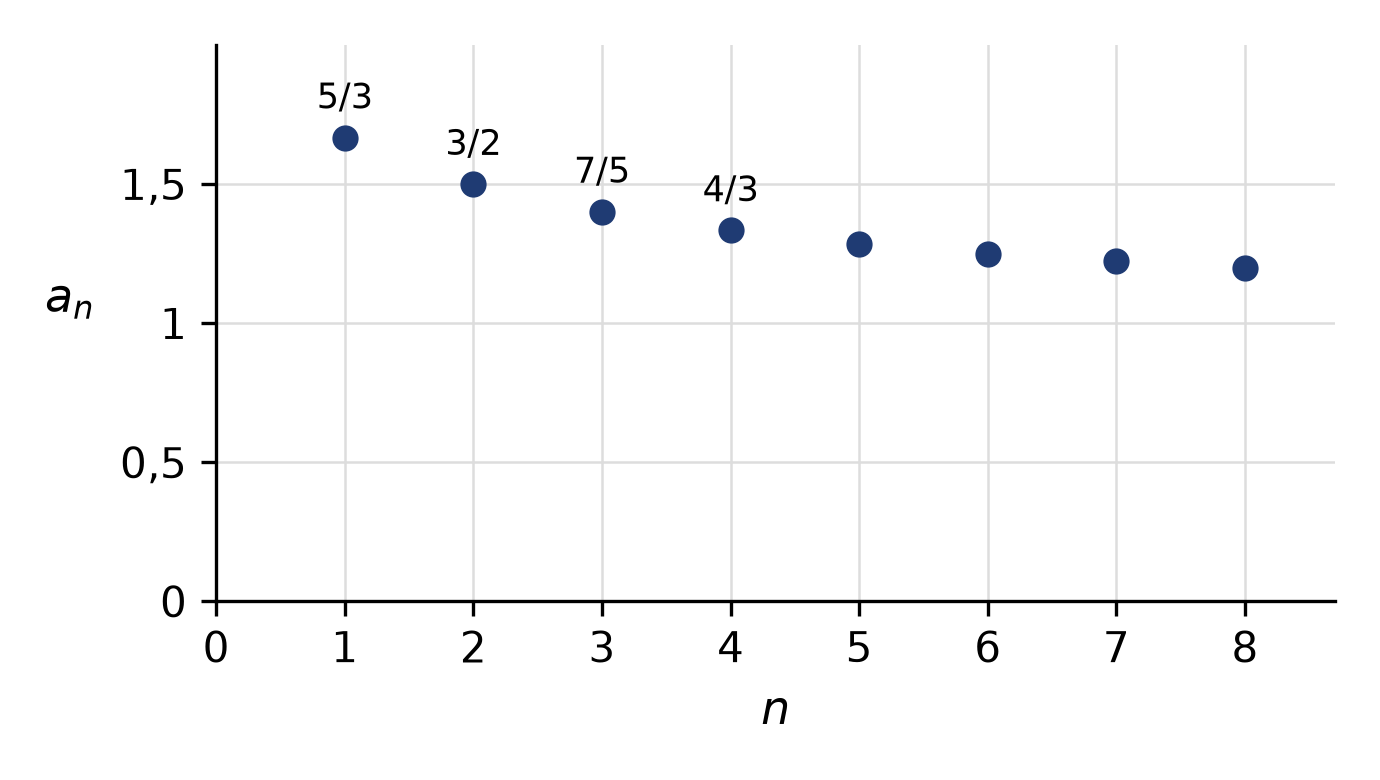
Let $(a_n)_{n\ge 1}$ be the sequence $a_n=\frac{n+4}{n+2}$.
a) The first four terms: $a_1=\frac{5}{3}$, $a_2=\frac{6}{4}=\frac{3}{2}$, $a_3=\frac{7}{5}$, $a_4=\frac{8}{6}=\frac{4}{3}$.
b) Is $\frac{13}{12}$ a term of the sequence? We solve $\frac{n+4}{n+2}=\frac{13}{12}$: $12n+48=13n+26$, so $n=22$. Yes, $\frac{13}{12}=a_{22}$.
c) The graph: the points $(n;\ a_n)$ for $n=1;\ 2;\ \ldots;\ 8$.
3. The sequence of partial sums
Definition
For a sequence $(a_n)_{n\ge 1}$ we write
$$S_n=a_1+a_2+\ldots+a_n=\sum_{k=1}^{n}{a_k}.$$
The sequence $(S_n)_{n\ge 1}$ is called the sequence of partial sums.
- $S_1=a_1$ and $S_n=S_{n-1}+a_n$, for $n\ge 2$.
- Conversely, if we know $S_n$: $a_1=S_1$ and $a_n=S_n-S_{n-1}$, for $n\ge 2$.
Careful! The formula $a_n=S_n-S_{n-1}$ does not apply for $n=1$. We check separately whether the formula we found also gives the term $a_1$.
Example 2
The sum of the first $n$ terms of a sequence is $S_n=n^2+3n$. We find $a_n$.
- $a_1=S_1=1+3=4$.
- For $n\ge 2$: $a_n=S_n-S_{n-1}=n^2+3n-(n-1)^2-3(n-1)=2n+2$.
- For $n=1$ the formula gives $2\cdot 1+2=4=a_1$. So $a_n=2n+2$ for every $n\ge 1$.
4. The general term from recurrence relations
4.1. Recurrences of the form $x_n=x_{n-1}+f(n)$
★ Method
Add the relations
- Write the relation for $n=2;\ 3;\ \ldots;\ n$: $x_2=x_1+f(2)$, $x_3=x_2+f(3)$, …, $x_n=x_{n-1}+f(n)$.
- Add the relations side by side. The terms $x_2;\ x_3;\ \ldots;\ x_{n-1}$ appear on both sides and cancel.
- What is left is $x_n=x_1+f(2)+f(3)+\ldots+f(n)$. Compute the sum with the known sums.
- Check the formula on $x_1$ and $x_2$.
Example 3
$x_1=1$ and $x_n=x_{n-1}+6n-5$, for $n\ge 2$.
Adding the relations: $x_n=1+\sum_{k=2}^{n}{(6k-5)}$. For $k=1$ the term $6k-5$ is exactly $1=x_1$, so
$$x_n=\sum_{k=1}^{n}{(6k-5)}=6\cdot \frac{n(n+1)}{2}-5n=3n^2-2n.$$
Check: $x_1=3-2=1$ and $x_2=1+7=8=12-4$. ✓
4.2. Recurrences of the form $x_n=x_{n-1}\cdot f(n)$
★ Method
Multiply the relations
- Write the relation for $n=2;\ 3;\ \ldots;\ n$: $x_2=x_1\cdot f(2)$, $x_3=x_2\cdot f(3)$, …, $x_n=x_{n-1}\cdot f(n)$.
- Multiply the relations side by side. Cancel $x_2;\ x_3;\ \ldots;\ x_{n-1}$ (they are nonzero).
- What is left is $x_n=x_1\cdot f(2)\cdot f(3)\cdot \ldots\cdot f(n)$. The fractions cancel “in a chain”.
- Check the formula on $x_1$ and $x_2$.
Example 4
$x_1=1$ and $x_n=\frac{2n}{n+1}\cdot x_{n-1}$, for $n\ge 2$.
$$x_n=1\cdot \frac{2\cdot 2}{3}\cdot \frac{2\cdot 3}{4}\cdot \frac{2\cdot 4}{5}\cdot \ldots\cdot \frac{2\cdot n}{n+1}.$$
The factor $2$ appears $n-1$ times. The fractions $\frac{2}{3}\cdot \frac{3}{4}\cdot \ldots\cdot \frac{n}{n+1}$ cancel “in a chain” and leave $\frac{2}{n+1}$. So
$$x_n=2^{n-1}\cdot \frac{2}{n+1}=\frac{2^n}{n+1}.$$
Check: $x_1=\frac{2}{2}=1$ and $x_2=\frac{4}{3}\cdot 1=\frac{2^2}{3}$. ✓
5. Monotonic sequences
Definition
The sequence $(a_n)_{n\ge 1}$ is:
- strictly increasing if $a_n<a_{n+1}$ for every $n\ge 1$;
- increasing if $a_n\le a_{n+1}$ for every $n\ge 1$;
- strictly decreasing if $a_n>a_{n+1}$ for every $n\ge 1$;
- decreasing if $a_n\ge a_{n+1}$ for every $n\ge 1$.
An increasing or decreasing sequence is called monotonic.
This is the monotonicity of the function $f:\mathbb{N}^*\to \mathbb{R}$, $f(n)=a_n$. For sequences it is enough to compare two consecutive terms.
A sequence is not monotonic if we find three terms that “go up and then down” (or the other way round). For example, $a_1<a_2$ and $a_2>a_3$.
Remember · Three methods
1. The difference. Compute $a_{n+1}-a_n$, simplify it and study its sign. If $a_{n+1}-a_n>0$ for every $n$, the sequence is strictly increasing. If $a_{n+1}-a_n<0$ for every $n$, the sequence is strictly decreasing.
2. The ratio. Use it only if all terms are strictly positive. Compare $\frac{a_{n+1}}{a_n}$ with $1$. If the ratio is greater than $1$, the sequence is strictly increasing. If it is less than $1$, the sequence is strictly decreasing. The method suits terms with powers or products.
3. Induction. Use it when the sequence is given by a recurrence $x_{n+1}=g(x_n)$. Check $x_1<x_2$ (or $x_1>x_2$). Show that $x_k<x_{k+1}$ implies $x_{k+1}<x_{k+2}$.
Example 5
a) The difference. $a_n=\frac{4n+1}{n+2}$.
$$a_{n+1}-a_n=\frac{4n+5}{n+3}-\frac{4n+1}{n+2}=\frac{(4n+5)(n+2)-(4n+1)(n+3)}{(n+2)(n+3)}=\frac{7}{(n+2)(n+3)}>0.$$
The sequence is strictly increasing.
b) The ratio. The sequence from Example 4: $x_n=\frac{2^n}{n+1}$. All terms are strictly positive.
$$\frac{x_{n+1}}{x_n}=\frac{2^{n+1}}{n+2}\cdot \frac{n+1}{2^n}=\frac{2n+2}{n+2}>1,$$
because $2n+2>n+2$ for every $n\ge 1$. The sequence is strictly increasing.
c) Induction. $x_1=1$ and $x_{n+1}=\frac{x_n+6}{3}$, for $n\ge 1$. We show that $x_n<x_{n+1}$ for every $n\ge 1$.
- Check: $x_2=\frac{7}{3}>1=x_1$.
- Inductive step: assume $x_k<x_{k+1}$. Then $x_k+6<x_{k+1}+6$, so $\frac{x_k+6}{3}<\frac{x_{k+1}+6}{3}$, that is $x_{k+1}<x_{k+2}$.
By the principle of mathematical induction, the sequence is strictly increasing.
Exercises
Basic level
-
Consider the sequence $(a_n)_{n\ge 1}$, $a_n=\frac{2n-1}{n+2}$.
a) Compute $a_1$, $a_2$, $a_3$ and $a_4$.
b) Show that $\frac{13}{9}$ is a term of the sequence and find its index.
c) Is the number $2$ a term of the sequence? Justify.
-
Write the first five terms of each sequence:
a) the sequence of prime numbers, in increasing order;
b) the sequence of nonzero perfect squares, in increasing order;
c) the sequence $(r_n)_{n\ge 1}$, where $r_n$ is the remainder of $n$ divided by $3$.
-
Find a possible formula for the general term, $n\ge 1$:
a) $3;\ 5;\ 7;\ 9;\ \ldots$
b) $\frac{1}{2};\ \frac{2}{3};\ \frac{3}{4};\ \frac{4}{5};\ \ldots$
c) $-1;\ 1;\ -1;\ 1;\ \ldots$
d) $0;\ 3;\ 8;\ 15;\ 24;\ \ldots$
e) $\frac{1}{3};\ \frac{1}{9};\ \frac{1}{27};\ \frac{1}{81};\ \ldots$
-
Recurrence relations.
a) The sequence $(x_n)_{n\ge 1}$ has $x_1=2$ and $x_{n+1}=2x_n-1$, for $n\ge 1$. Compute $x_2$, $x_3$, $x_4$ and $x_5$.
b) The first terms of a sequence are $1;\ 4;\ 13;\ 40;\ 121$. Find a recurrence relation of the form $x_{n+1}=a\cdot x_n+b$ that generates them.
Hint: compare each term with three times the one before it.
-
Let $a_n=(-1)^n\cdot (2n-1)$, $n\ge 1$. Write the first five terms, then compute $S_1$, $S_2$, $S_3$, $S_4$ and $S_5$.
-
Study the monotonicity of the sequences using the difference:
a) $a_n=5-\frac{2}{n}$;
b) $b_n=\frac{n+4}{n+1}$.
Intermediate level
-
Find the general term $a_n$ of the sequence whose sum of the first $n$ terms is:
a) $S_n=3n^2-n$;
b) $S_n=n^2+n+1$.
Hint: in b) compare the formula you get for $n\ge 2$ with $a_1$.
-
Find the general term of the sequence:
a) $x_1=2$, $x_n=x_{n-1}+6n-2$, for $n\ge 2$;
b) $x_1=4$, $x_n=x_{n-1}+3n^2+1$, for $n\ge 2$.
Hint: use the sums $\sum_{k=1}^{n}{k}$ and $\sum_{k=1}^{n}{k^2}$.
-
Find the general term of the sequence:
a) $x_1=1$, $x_n=\frac{n+2}{n-1}\cdot x_{n-1}$, for $n\ge 2$;
b) $x_1=4$, $x_n=\frac{n-1}{n+1}\cdot x_{n-1}$, for $n\ge 2$.
-
Study the monotonicity of the sequences using the ratio:
a) $a_n=\frac{n}{3^n}$;
b) $b_n=\frac{2\cdot 5\cdot 8\cdot \ldots\cdot (3n-1)}{3\cdot 6\cdot 9\cdot \ldots\cdot (3n)}$.
-
A video has $10$ views on its first day online. On each following day, the number of views on day $n$ is $2n$ more than on the day before.
a) Let $x_n$ be the number of views on day $n$. Write the recurrence relation.
b) Find the general term $x_n$. How many views does the video get on day $10$?
c) How many views does the video get in total over the first $10$ days?
-
The sequence $(x_n)_{n\ge 1}$ has $x_1=5$ and $x_{n+1}=\frac{x_n+3}{4}$, for $n\ge 1$. Show by induction that the sequence is strictly decreasing.
Advanced level
-
The sequence $(x_n)_{n\ge 1}$ has $x_1=1$ and $x_n=\frac{n(n+1)}{(n-1)(n+2)}\cdot x_{n-1}$, for $n\ge 2$.
a) Find the general term.
b) Study the monotonicity of the sequence.
Hint: split the product into two “chains”: $\frac{2}{1}\cdot \frac{3}{2}\cdot \ldots\cdot \frac{n}{n-1}$ and $\frac{3}{4}\cdot \frac{4}{5}\cdot \ldots\cdot \frac{n+1}{n+2}$.
-
Let $a_n=\frac{n^2}{2^n}$, $n\ge 1$.
a) Show that $\frac{a_{n+1}}{a_n}<1$ if and only if $n^2-2n-1>0$.
b) Compute $a_1$, $a_2$, $a_3$, $a_4$. Is the sequence monotonic? From which index on do the terms decrease?
-
The sequence $(x_n)_{n\ge 1}$ has $x_1=1$ and $x_{n+1}=\sqrt{x_n+2}$, for $n\ge 1$.
a) Show by induction that $x_n<2$ for every $n\ge 1$.
b) Show by induction that the sequence is strictly increasing.
-
Back to the sequence from exercise 4 a): $x_1=2$, $x_{n+1}=2x_n-1$.
a) Compare the terms $x_1;\ \ldots;\ x_5$ with the powers of $2$. Guess a formula for $x_n$.
b) Prove the formula by mathematical induction.
For those who want more
-
Find the real numbers $m$ for which the sequence $a_n=\frac{n+m}{2^n}$, $n\ge 1$, is strictly decreasing. What happens for $m=0$?
Hint: use the difference. Why can we not use the ratio for every $m$?